Selective Data Transition: The Best of Both Worlds
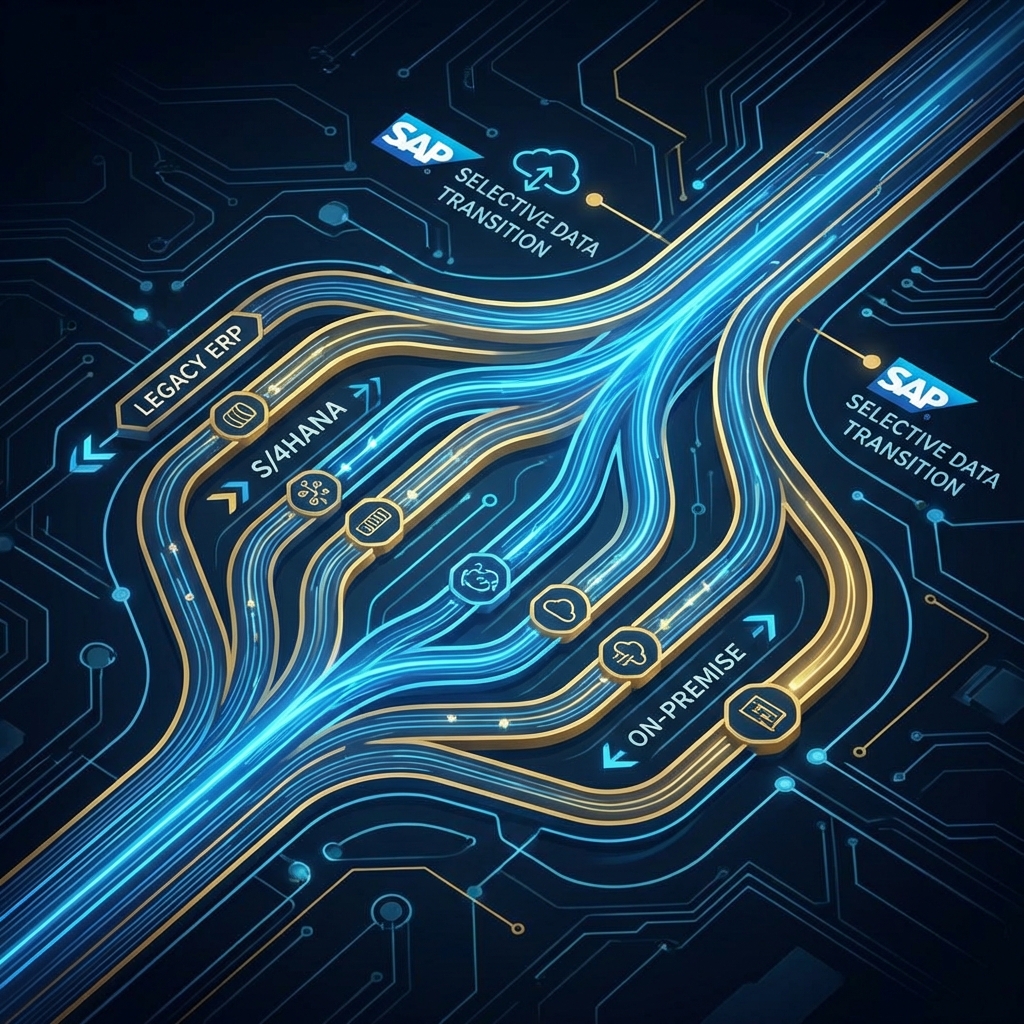
For years, the choice in SAP interaction was binary: Greenfield (New Implementation) or Brownfield (System Conversion). Selective Data Transition (SDT), often called "Bluefield" or "Hybrid," has emerged as the strategic third option for enterprises that refuse to compromise.
What is Selective Data Transition?
SDT enables organizations to migrate to SAP S/4HANA by selecting only the specific data they need from their legacy ERP landscapes. Unlike a full conversion, which brings over every historical quirk and technical debt, SDT allows for a clean sweep of configuration while preserving critical historical data (e.g., 2 years of sales history, 5 years of audit logs).
The Strategic Advantages
- Technical Debt Reduction: Start fresh with new configuration and clean ABAP code, leaving behind decades of customization bloat.
- Data Minimization: Migrate only relevant active data, reducing the HANA memory footprint and associated licensing costs.
- Harmonization: Consolidate multiple legacy ERPs into a single global S/4HANA instance with unified master data governance.
The Mechanics of SDT
Executing an SDT project requires specialized tooling—standard migration cockpit (LTMC) is insufficient. We utilize landscape transformation middleware (like SAP SLT or specialized partner tools) to perform shell creation (copying configuration without data) and then selectively pump data into the new target structures.
The "Time-Slice" Approach
A common SDT pattern is the "Time-Slice." For example, migrating all open items + 2 years of closed history. This keeps the new system lean while satisfying operational reporting needs, with older data archived in a lower-cost data lake.
Conclusion
Selective Data Transition is not just a technical migration path; it is a business transformation enabler. It provides the agility of a new implementation with the continuity of a conversion, offering a tailored path to the Intelligent Enterprise.